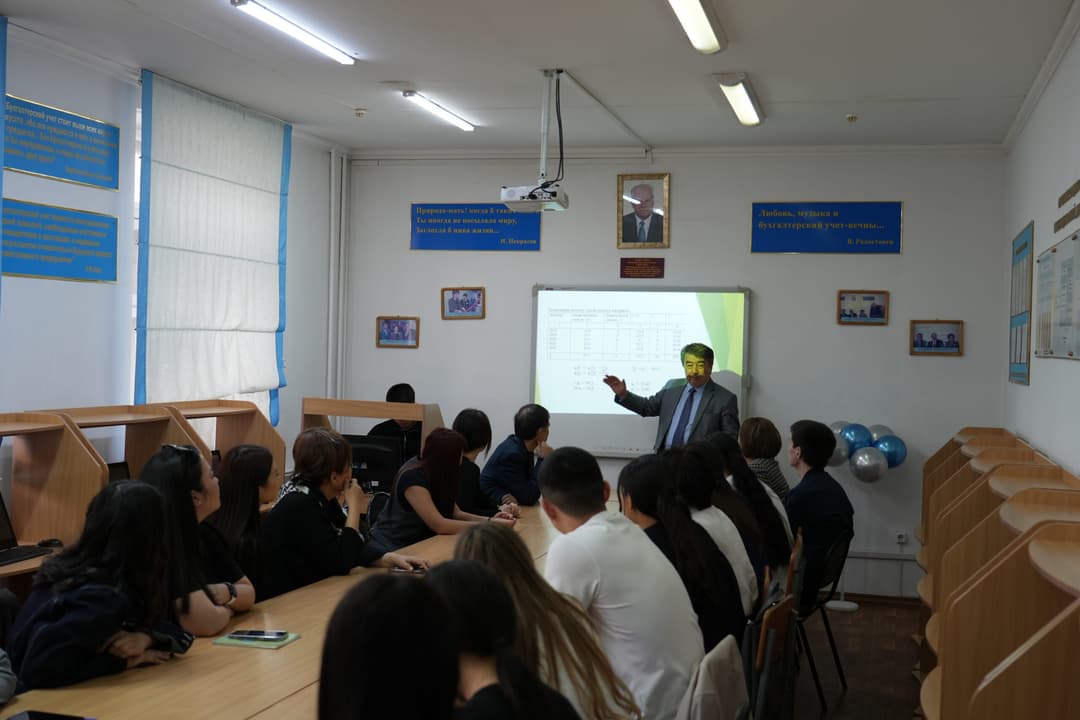
Within the framework of Statistics Week, on 9 April, the Department of Accounting and Audit held an academic and methodological seminar on the topic "Interactive Teaching Methods in Higher Education." The report was delivered by Abdurakhmanоv Mirzatilla Abdullayevich, Candidate of Economic Sciences, Associate Professor of the Department of Accounting and Audit.
The event was attended by faculty members of the Department of Accounting and Audit at Esil University: Bekzhanova Toty Kalzhanovna (Candidate of Economic Sciences, Acting Professor), Altynbekov Miyatbek Altynbekovich (PhD, Acting Professor), Aitkhozina Lyazzat Zhumabaevna (Candidate of Economic Sciences, Associate Professor), Uspambaeva Madina Karabaevna (PhD, Senior Lecturer), and Oralbekova Zhanat Kurbanova (Master's degree, Lecturer).
The seminar was devoted to current issues of modernizing the educational process in the context of digitalization and the development of a competency-based approach. The presentation addressed both theoretical and practical aspects of applying interactive teaching methods aimed at increasing student engagement and motivation, developing critical thinking, and enhancing communicative skills.
Special attention was devoted to contemporary forms of interactive engagement: case studies, role-playing and business games, debates, brainstorming sessions, interactive lectures, master classes, and web quests. Opportunities for the integration of digital technologies into the educational process through the use of online platforms and visual modelling tools were also presented.
The discussion component of the seminar involved faculty and second-year students of the Faculty of Business and Management in the educational programmes of Statistics, Accounting and Audit, Finance, and Economics, who discussed the key aspects of building an effective educational environment aimed at developing research, creative, and analytical competencies.
Following the discussion, participants emphasised that the use of interactive methods in the educational process not only contributes to a deeper mastery of academic material but also cultivates in students the professional skills demanded by the modern digital economy. The seminar served as a significant platform for the exchange of experience, methodological insights, and discussion of prospects for improving pedagogical approaches in higher education.