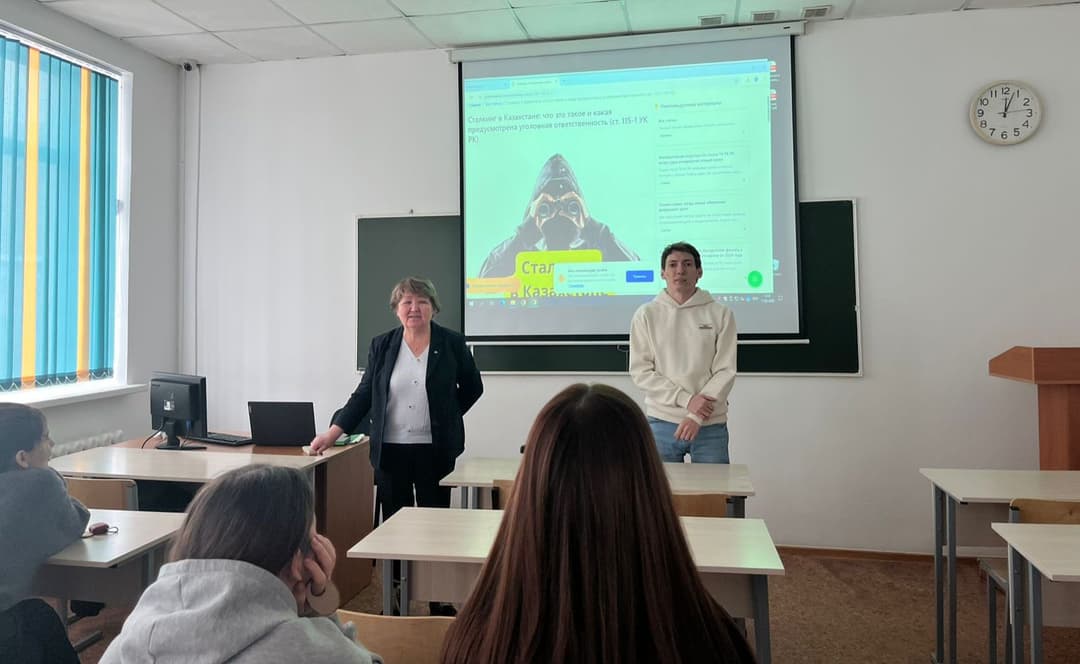
Within the framework of discussions on the Concept "Children of Kazakhstan 2026–2030," senior lecturers of the Department of Social Work and Tourism, Arystanova Z.S. and Savvin E.V., conducted a tutoring session for first-year students of the specialisation "Social Work," Group B SW-25\1R, on the topic "Who is a stalker and how to resist stalkers?"
Since September 16, 2025, Kazakhstan has enforced a law on criminal liability for stalking — obsessive persecution causing psychological harm to the victim. President Kassym-Jomart Tokayev signed the law, which also provides for liability for coercion into marriage.
During the session, it emerged that some students had already encountered this form of violence. Stalkers can be both strangers and acquaintances — friends, former colleagues, or classmates. The most common victims are young women aged 18–24. Stalking manifests through unexpected appearances near the victim, surveillance, leaving notes or gifts, and interference through friends and relatives. The perpetrator ignores requests to stop, causing fear and anxiety in the victim, and in some cases may escalate to physical violence or murder.
Students discussed the types of stalking and protective measures: minimising contact with the perpetrator, ignoring attempts at communication, changing routes and travel times, and restricting interaction on social media — not responding to messages and leaving chats involving threats.