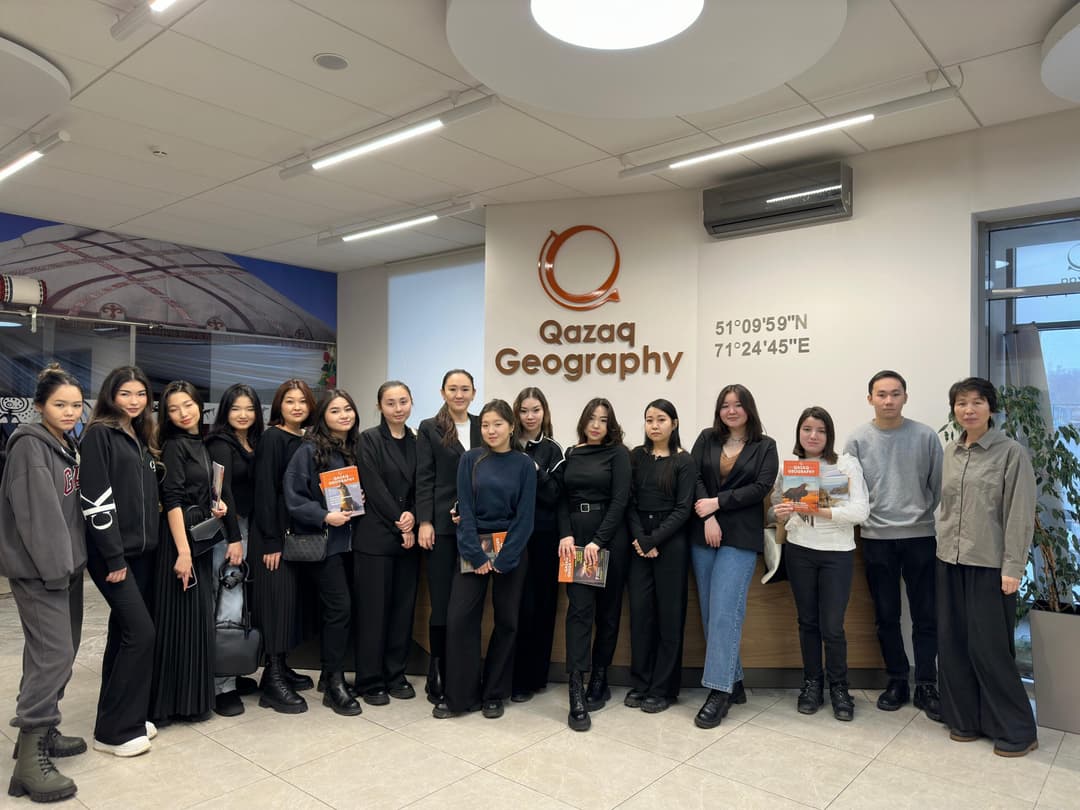
Third-year students of the Tourism educational programme, accompanied by faculty members of the Department of Social Work and Tourism, A.G. Gizzatzhanova and M.A. Muslimbekova, visited the non-commercial republican public association QazaqGeography.
The event took place in Astana, at the QazaqGeography building located at 22 Abay Street, from 12:00 to 15:00. As part of the visit, a lecture was organised on the topic: "Visitor Centres in Kazakhstan's National Parks: Their Role in the Development of Ecotourism."
"QazaqGeography" is the national geographical society of Kazakhstan, founded in 2013, which unites more than 1,000 members throughout the country. The Society is actively engaged in scientific and research activities, and also implements projects aimed at the preservation of cultural and natural heritage, and the development of ecotourism and sustainable tourism in Kazakhstan. The organisation works with more than 50 partners and has, to date, implemented more than 70 socially significant projects.
The objective of the event was to familiarize students with the activities of QazaqGeography and to deepen their knowledge of the significance of visitor centres in national parks for ecotourism. During the lecture, students learned about the important role that visitor centres play in promoting the natural and cultural values of Kazakhstan, as well as how these centres contribute to the sustainable development of ecotourism and environmental education.
The lecture was delivered by Kinayatova Madina and Beisenova Zhansaya, who spoke about the significance of visitor centres in Kazakhstan's national parks for the development of ecotourism and the preservation of cultural heritage. They explained how visitor centres serve as educational and informational platforms, providing tourists with the opportunity to learn about the natural riches and cultural characteristics of the region. The speakers also shared successful examples of projects aimed at sustainable tourism development and emphasised the importance of balancing tourism activities with environmental protection. Students gained an understanding of how ecotourism contributes to the promotion of cultural heritage and the development of environmentally sustainable tourist routes in Kazakhstan.
The students engaged enthusiastically in asking questions, demonstrating a profound interest in the topic of ecotourism and the role of visitor centres in national parks. Questions addressed both the practical aspects of visitor centre operations and broader issues of sustainable tourism, the preservation of cultural and natural heritage, and the possibility of incorporating such facilities into tourist routes. The speakers were pleased to share their knowledge and experience, answering the students' questions and explaining how ecotourism can contribute to both tourism development and environmental protection.
The visit to "QazaqGeography" became an important component of the students' educational programme, broadening their understanding of the role of ecotourism in the contemporary tourism industry and how cultural heritage and natural resources can be effectively utilized to create unique and sustainable tourist products.