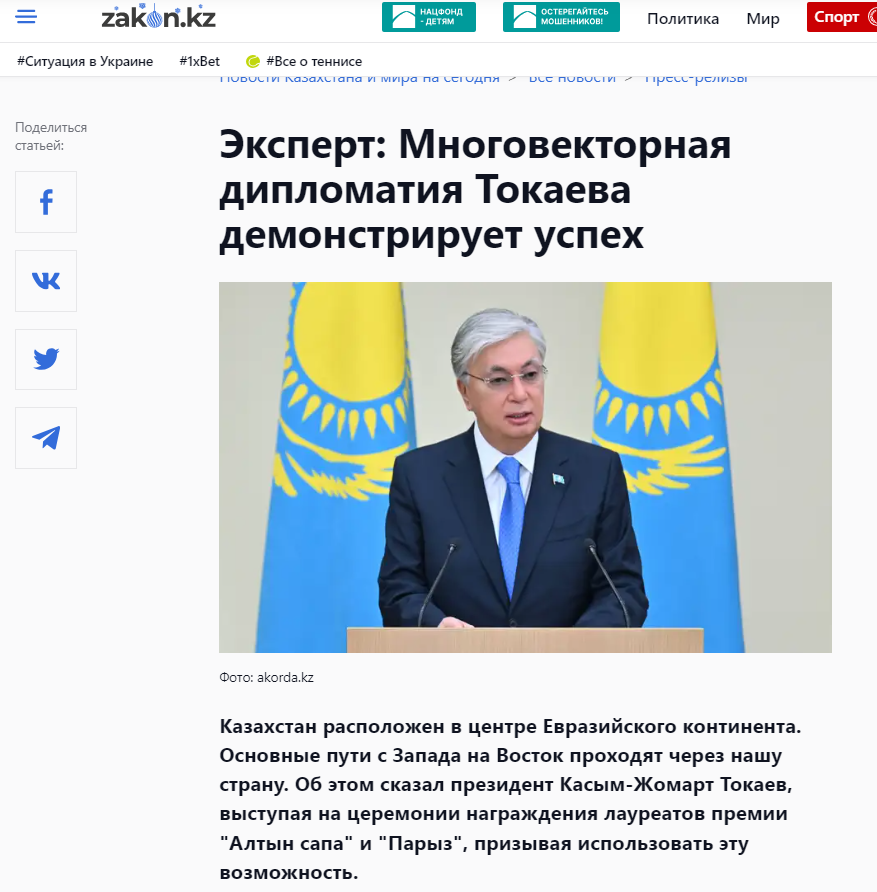
Kazakhstan is located at the center of the Eurasian continent. The main routes from West to East pass through our country. This was stated by President Kassym-Jomart Tokayev, speaking at the award ceremony for the laureates of the "Altyn Sapa" and "Paryz" prizes, calling upon all to utilize this opportunity.
Candidate of Historical Sciences, expert Marat Uteubaev shared his views on what has changed in Kazakhstan's domestic and foreign policy over the past year.
– Marat Toleutemirovich, in your opinion, what significant changes took place in the political sphere in 2023?
– In March of this year, Kazakhstan held its first elections to the Mazhilis of the Parliament of Kazakhstan under President Kassym-Jomart Tokayev. These elections represented a continuation of the systemic political reforms launched by the Head of State in 2022. The results of the elections to the Mazhilis of the country's parliament and maslikhats at all levels concluded the electoral process that commenced the previous year.
By the decision of the Head of State Kassym-Jomart Tokayev, a nationwide referendum was held on amendments to the country's Constitution, which transformed Kazakhstan from a super-presidential republic into a presidential republic with a strong parliament. In November 2022, extraordinary presidential elections were held, and in January 2023, following the elections, the Senate of the Parliament of Kazakhstan was partially renewed.
The electoral procedure for the Majilis of Parliament was amended: whereas previously all deputies were elected from party lists, under this model the parliamentary elections resulted in 70% of the lower chamber being formed through party lists, while the remaining 30% were elected from single-member constituencies. The registration procedure for political parties was simplified — now 5,000 members suffice, rather than the previous 20,000. In addition, a "against all" option was introduced on ballots, and the threshold for a party to enter the Majilis of the Parliament of Kazakhstan was lowered from 7% to 5% of votes. Seven parties were registered for these elections, including two newcomers: the ecological party "Baytaq" and Respublika.
Elections to the maslikhats also took place under the new electoral system. At the regional level, maslikhats were formed with 50 per cent of seats allocated through party lists and 50 per cent through single-member constituencies. At the district level, maslikhats were formed entirely of self-nominated candidates.
Political reforms were carried out in the spirit of the formula proclaimed by our President: "a strong President — an influential Parliament — an accountable Government." In my view, by mid-2023 Kazakhstan had completed the reset and renewal of all major political institutions: the President, the Parliament, and the Government of the country. Kazakhstan maintains strong presidential authority while the role of the country's Parliament is gradually being strengthened.
— In 2023, the revived Constitutional Court began its work in Kazakhstan. It was reported that more than 4,000 applications from Kazakhstani citizens had been received since the beginning of the year. In your opinion, what significance does the return of the Constitutional Court hold for society and the country?
"Now every citizen will be able to directly defend their rights and freedoms in the Constitutional Court. In my view, with the decision to restore the Constitutional Court, Kassym-Zhomart Tokayev has begun forming legal institutions for state governance in the country. In general, it is clear that the head of state has been preparing the idea of a major reform of the legal system for quite some time."
It should be noted that calls for the restoration of the Constitutional Court in Kazakhstan have been voiced for a long time, particularly by many lawyers and experts. The abolition of the Constitutional Court since 1995 was a significant mistake from the perspective of upholding the foundations of a democratic society and observing human rights.
Undoubtedly, the restoration of the Constitutional Court is a benefit for our country; however, without a systematic and well-considered reform and modernisation of Kazakhstan's entire judicial system, this legal domain will not function to its full potential. A comprehensive reform of Kazakhstan's entire legal and judicial system is required. Overall, the head of state's decision to establish the Constitutional Court is entirely justified, correct, and warranted from the perspective of developing a rule-of-law state and society.
– What are your thoughts on Kazakhstan's foreign policy strategy under the leadership of Kassym-Jomart Tokayev? What significant events for the country took place in 2023 in the sphere of international relations?
— The foreign policy of Kassym-Jomart Tokayev is grounded in the concept of multi-vector diplomacy. The President of Kazakhstan consistently strengthens relations with a broad range of influential actors — Russia, China, Europe, the United States, Turkey, and the Arab world. Kazakhstan is a member of numerous international organisations, including the UN, the OSCE, the CICA, the OIC, the EAEU, the CSTO, and others.
Over the past year, Kazakhstan has remained committed to its multi-vector path — an achievement that is not easily attained in a complex geopolitical environment characterised by political tension between Russia and the West, the United States and China, while Kazakhstan borders both Russia and China and simultaneously builds relations with Western countries and the United States. In this multifaceted foreign policy environment, a balance was maintained throughout the year, and the Head of State's carefully considered foreign policy programme strategy has demonstrated its success.
Regarding recent events, the process of demarcating the state border between Kazakhstan and Uzbekistan was completed this summer. The demarcation process took 19 years, during which negotiations were conducted, numbering well over one hundred.
Of significant importance for strengthening strategic economic partnership was the participation of the President of Kazakhstan in the "Central Asia – China" summit held in the city of Xi'an. The summit identified priority areas of cooperation between Astana and Beijing: increasing trade turnover to USD 40 billion, strengthening logistical infrastructure — including, for example, the resumption of operations at the Khorgos International Centre of Cross-Border Cooperation on the Kazakhstan–China border. The parties agreed to cooperate in the field of e-commerce and on numerous other matters. Agreements worth USD 22 billion were signed in Xi'an. Of particular importance is the mutual and fully reciprocal visa-free regime for citizens of Kazakhstan and China.
Furthermore, in October of this year, the Third Forum on International Cooperation "Belt and Road" was held in Beijing. Kazakhstan is making serious efforts to become a transport and logistics hub at the heart of the Eurasian continent. As is well known, approximately 85 percent of all overland transit freight from China to Europe currently passes through Kazakhstan.
It is also worth dwelling on the expansion of Kazakhstan's cooperation with the European Union. In early June of this year, a second high-level meeting was held in Cholpon-Ata, attended by the leaders of the Central Asian states and the President of the European Council.
A significant event was the 78th Session of the United Nations General Assembly in New York, where Kazakhstan's President Kassym-Jomart Tokayev served as session moderator and participated in negotiations in the "C5+" format with the leaders of Central Asian countries and the President of the United States.
In general, President Kassym-Jomart Tokayev's diplomatic strategy has demonstrated its success for several years running. Today, our country is a major regional power that aspires to become a universally recognized leader not only in Central Asia but across Eurasia, and which actively participates in shaping the international agenda.
Источник: https://www.zakon.kz/press-relizy/6418096-ekspert-mnogovektornaya-diplomatiya-tokaeva-demonstriruet-uspekh.html